Saturday, February 28, 2015

Happy Entrails To You, Until We Eat Guai Jubb Again (Amphawa Thai Noodle House)


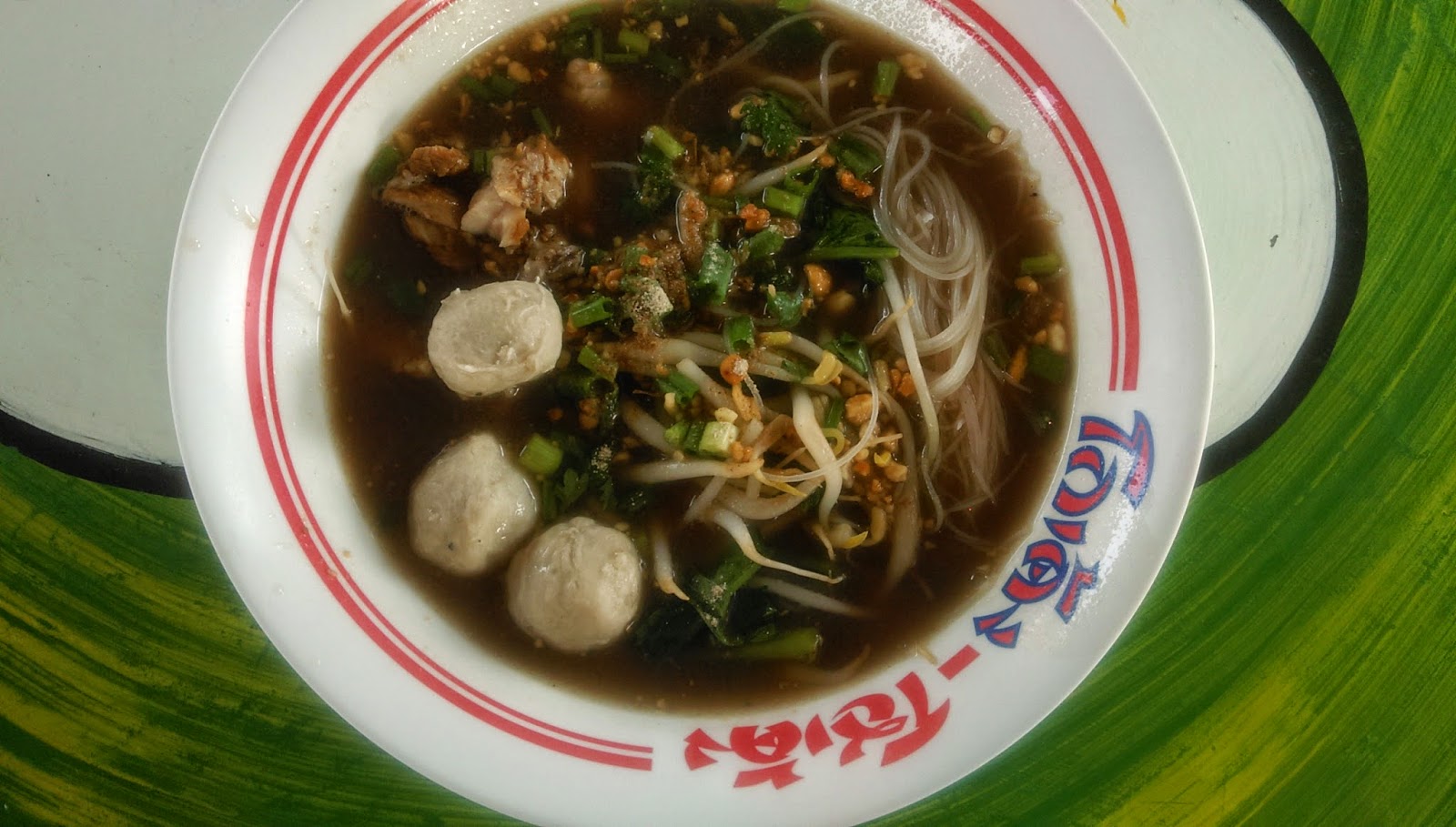
Jenny, my recently enlisted Thai noodle soup consultant (see previous post) Skyped me pics of two noodles dishes she had just cooked for her family (not available in her restaurant, which only serves Boat Noodles).  One of the two looked particularly interesting, and some tweaking of her spelling and Googling proved it to be a dish I will call Guai Jubb. I vowed to find it in San Francisco and sure enough, Amphawa Thai Noodle House, where I previously experienced my first sukhothai, came through again.

Guai Jubb (Amphawa's spelling), or guay jab or kuay jub or jab, is a soup featuring pork offal and thin rice flour noodles, often of a distinctive fomation.  Some local colloquial names for it include "Vietnamese" rice noodle soup and "sticky"soup, though I didn't find anything Vietnamese or sticky about it other than some 5-spice notes in the broth, and the fact that it's definitely a "stick-to-the-ribs" noodle soup.

Amphawa's menu describes the soup as "Square rice noodles in House special broth with pork entrails, crispy pork, egg, and pork blood pudding."  The square noodles were in fact thin rice noodles alost the size of won ton skins, rolled up like a carpet or a cigar. (I'm not really sure if they were square, as I found recipes that called for triangles, but I didn't unroll one to check.)

There were pork entrails a-plenty, mostly unidentifiable by me but tender and tasty, and some hearty congealed pork blood cubes. The "crispy pork" consisted of crumbles of crispy cooked pork belly, a nice contrast in  flavor and textures. Protein variety was enhanced with the addition of two photogenic boiled egg halves. The broth was soy sauce based, slightly tart, and slightly peppery, with a faint aromatic cast.  It didn't seem to be as characteristically peppery as some descriptions of the dish would have you believe, but along with the usual three-compartment relish caddy, the server brought a container of the super-potent house-made green chili sauce. I took this as a hint, and a little dab of this made the whole concoction really sing.


I ordered a "Thai Iced Tea Lemonade" to wash it down with. It was similar to Tycoon Thai's Thai Lime Tea, but with lemons instead of limes and sweeter.  It was, in fact, a little too sweet for my taste but I would order it again if I could specify a lesser degree of sweetness.

Over all, it was an exciting bowl of noodles and a likely shoo-in for my "Best of 2015" list (if I do one). I'll be back, Pilgrim.  Rustle me up some jubb.

Where slurped: Amphawa Thai Noodle House, 5020 Geary Boulevard, San Francisco.

[Addendum: Another correspondent, Thai food scholar Leela Punyaratabandhu advises that Guai Jubb is based on a Chaozhou Chinese dish, kway chap (粿汁).  That makes sense, since 72% of Chinese in Thailand are Teochew (Chaozhou) or Hakka Chinese. It also may have brought to parts of Thailand via Vietnam by migrating Teochew or Hakka Chinese, which would explain why some Thais call it "Vietnamese" soup.]

Friday, February 20, 2015

Meet Full Noodle Frontity's New Pen Pal, Goong's Noodle Shop In Northeastern Thailand

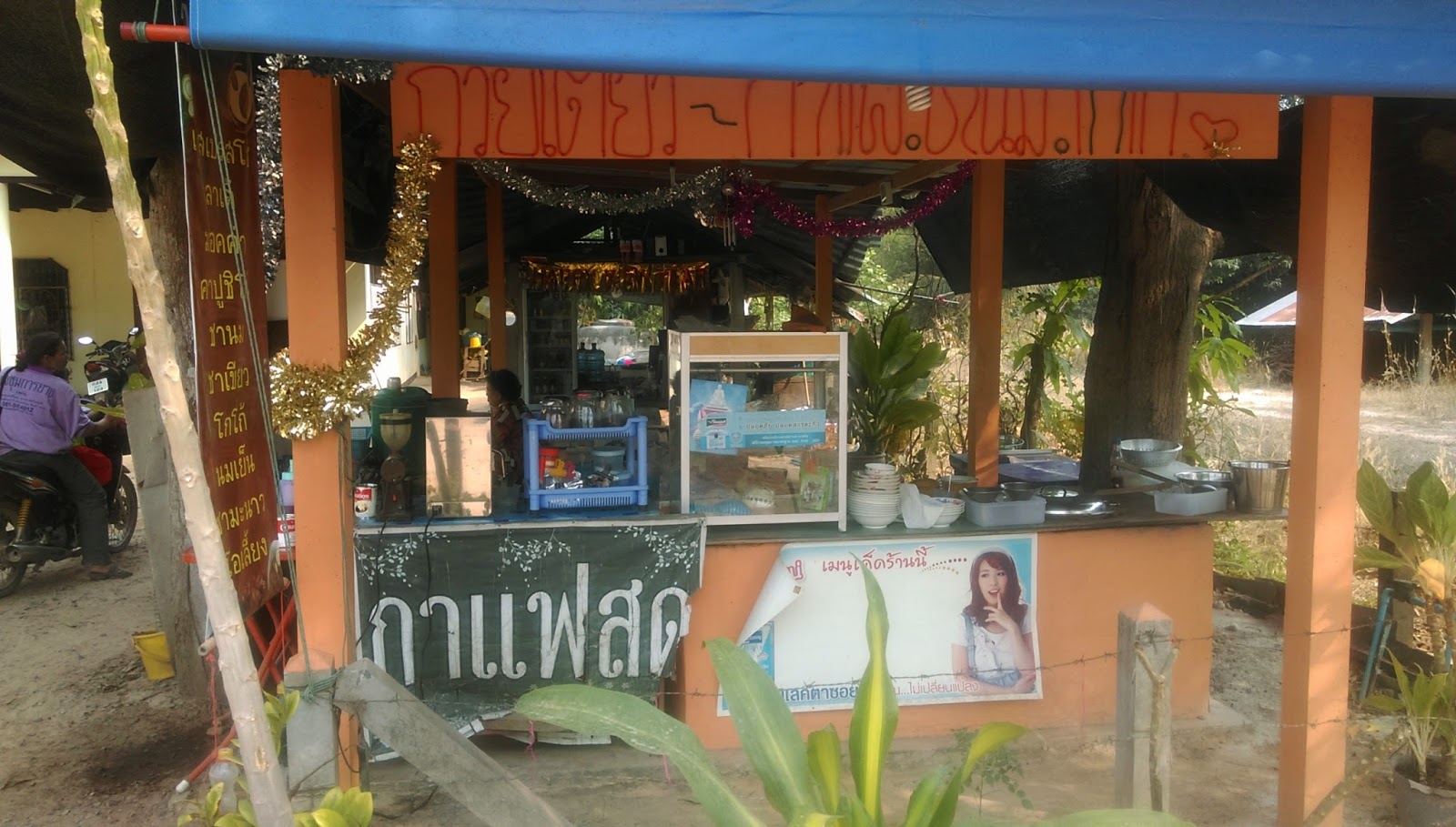
The noodle shop's festive front
As a child I was always interested in what everyday life was like in other parts of the world, perhaps influenced by the Olive Beaupre Miller and Rudyard Kipling story books we had around. I wanted to have my own personal contacts scattered around the globe, and in those days of expensive and relatively primitive  communication options, the mails and pen pals were the way to go. By the time I reached puberty I had pen pals in Japan, England and Finland. (I don't recall how the choices were made, but all three were girls.)

Why would my blog want a "pen pal"? It's all about continuity.  So far, Full Noodle Frontity has been about discovery, always looking for a new country's noodles to try, new noodle dishes to try, or simply new restaurants to try favorite noodle dishes. It has occurred to me that I can also push my noodle knowledge forward by observing a single establishment over time, even one offering only a single iconic noodle dish. Observing its ins and outs and its ups and downs would certainly enhance my knowledge of noodle culture. That's where this simple noodle shop in Thailand, hopefully, comes in. It's in a favorite noodle country of mine, it serves a favorite noodle dish of mine, it has a friendly proprietress, and, thanks to the Internet, I have an almost on-demand line of communication to it.

Jenny's Boat Noodles

It began as a random on-line meeting:.a casual glance across the room that is the Internet, a nod, a smile, and in no time at all, Jenny in Thailand and I in San Francisco were conversing intimately.about.... noodles.

I had broken the ice by telling Jenny how much I liked Thai food, especially noodles.  I boasted about my noodle blog, and sent her a link.  Finally I got around to asking her what she did.

"I'm a merchant, I have a small shop selling noodles and coffee," she wrote.

"What kind of noodles? Pad Thai?" "Wait a sec," she wrote, and sent me a picture. I stared at it.

"Boat noodles!" I exclaimed. "Yes," she wrote.

It was foodie love at first Skype!

Where's Jenny?
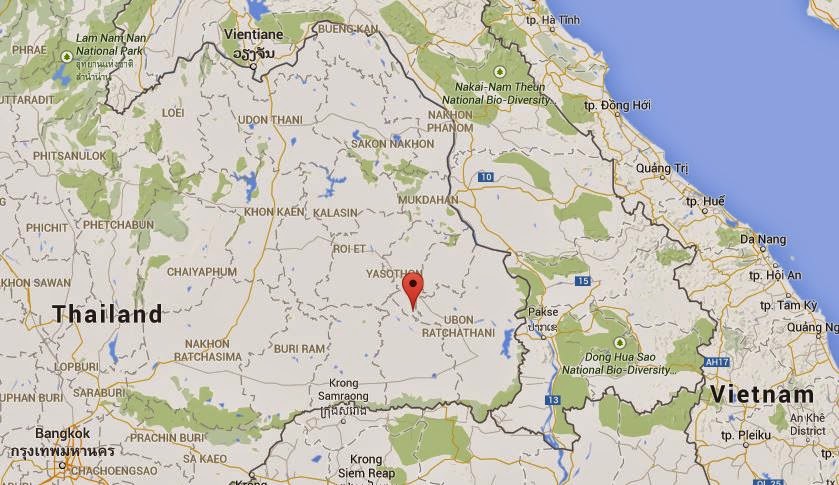
Jenny lives in a very remote part of Northeastern Thailand, in Khowang District, Yasothon Province, close to the borders of both Laos and Cambodia. The noodle shop Jenny built two years ago is a simple shop, attached to her house, with a very small menu. It doesn't even have a name; locals call it "Goong's Noodle Shop" after a nickname for her Thai name. Nonetheless, Jenny is very social media savvy and has a good internet connection, When I asked another question about her shop it was "Wait a sec" again and she put through a video call and scanned her fiefdom with her phone's camera, giving me a panoramic view for my own eyes. Such is the age we live in!

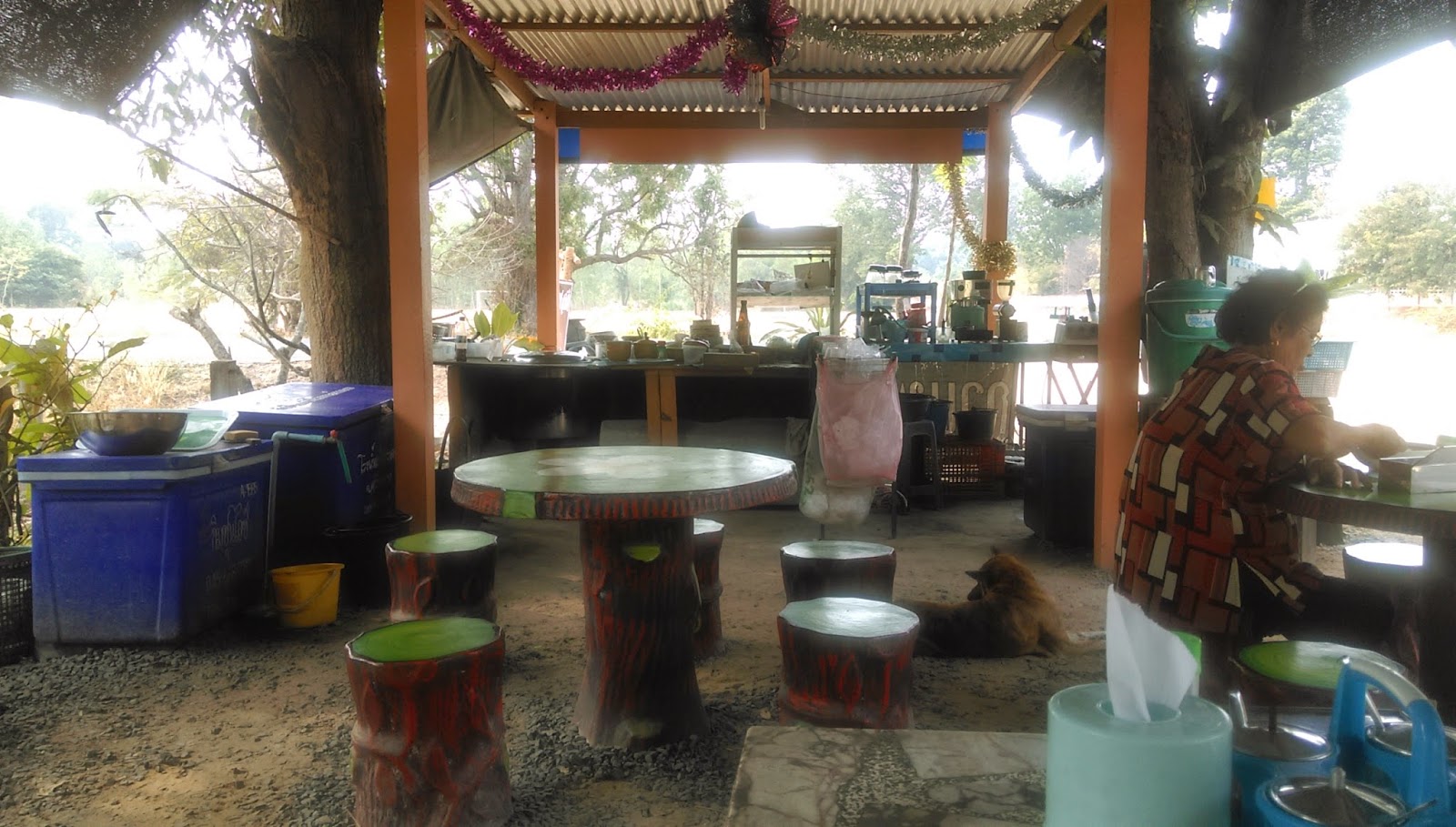
The noodle shop's serene interior
Behind the festive, if hectic, shop front in the picture at this top of this page lies a surprisingly serene, clean and orderly space for you to enjoy and contemplate the elaborate bowl of boat noodles you have come for. Jenny's establishment, or Goong's Noodle Shop, if you will, features a dish beloved all over Thailand, Boat Noodles, which I described briefly in an earlier blog post.  You can learn a lot more about the history and lore of this dish in a Migrationology video by Mark Wiens.  

Jenny's soup comes with a broth that is enriched with with pork blood in typical Boat Noodle style; .I know of quite a few Asian soups that use cubes of congealed pig's blood as a garnish, but not many that I am aware of use it as a key ingredient in the broth base. This may seem off-putting to a Westerner, but it makes for a smooth, rich soup and you wouldn't even know it was due to animal blood if no one had told you.

There are only the two traditional Boat Noodle protein choices here, beef or pork, though you'll find pork meatballs in either, along with complex seasoning and garnishment, When it come to noodle styles for your soup, there is a wider range of choices. You can have thin or wide (flat) rice noodles, Chinese-style egg noodles (which Jenny seems to prefer), bean thread noodles or instant noodles. There's coffee to be had, but more importantly (to me at least) beer. The house beer is Leo, which is Singha Beer's little brother. Judging from the video call snippet Jenny treated me to, there will also be some spirit-lifting Thai pop music.

Jenny!
When I asked Jenny how a traveler would find her shop she at first demurred, saying her small village was not on the tourist trail, but I convinced her there would always be crazies like Andy Ricker and me who would look for the smallest village noodle shop they had heard of.  We agreed that one should just find the Khowang District in Yasothon Province, Thailand, and ask someone to point them toward Goong's Noodle Shop.

Now that I've "adopted" this modest Thai noodle shop as my blog's cyber-penpal, I plan to be checking on it often. Look for Full Noodle Frontity to report back from time to time with as many pictures, stories, and videos I can coax out of Jenny (and who knows, maybe even a recipe or two).  If you find yourself in her neighborhood, seek her noodle shop out, and show her how crazy for Thai Boat Noodles a foodie can be.

Wednesday, February 11, 2015

A Bloody Good Kao Piak At Tycoon Thai, Mason Jars Or Not


What is it with Asian restaurants and Mason jars? One would think an Asian restaurant in San Francisco that served all its drinks (including local craft beer) in hipster fetishist Mason jars would be serving dumbed-down, er, "gateway" Asian food. If I'd bet on that assumption, I'd be 0-for-2 by now.  First came O'Mai Cafe at the trendier end of Clement, where my Vietnamese iced coffee was served in a Mason jar alongside my anatomically correct bun bo Hue An now comes Tycoon Thai, in the Tenderloin, no less....

Tycoon Thai is a recently opened Thai restaurant (I'd call it Thai/Lao) that opened in the former Pop-up Cafe space.  Among the Lao and Isan Thai dishes listed on its menu is Kao Piak (also known as Kao Piak Sien), the chicken noodle dish considered to be Laos' national dish. Since Lao food has historically been scarce in San Francisco compared with other Asian cuisines, I was pleased to be offered the chance to experience a third version of the dish I'd previously sampled at Champa Garden (SF) and Maneelap Srimangkoun.

Tycoon Thai is all tall tables and bar stools, and on arrival I perched at a window counter to watch O'Farrell St. life go by. After being brought my menu and a glass of water (startlingly served in a Mason jar) I ordered the kao piak along with a cha ma now (Thai lime iced tea), which also was to come in a Mason jar. I normally would have added an appetizer, but at Tycoon Thai they all seem priced and sized for sharing, not for solo diners, so the sai ua and the som tum Lao will have to wait for further visits.

The kao piak on Tycoon Thai's menu is described as "homemade rice flour noodle" with "rice flour, chicken. (optional pork blood), topped with green onion and fried garlic." It's also tagged as "Laos' signature). It was the pork blood option that excited me, not that congealed pig's blood cubes have much to offer other than color and texture, but it seemed an offer of another degree of authenticity, as neither of the two versions I had previously had the option.  So how did Tycoon Thai's version of Kao Piak stack up against Champa Garden's and Maneelap Srimongkoun's?

Overall, Tycoon Thai's version was quite similar to Maneelap Srimongkoun's version. Though the latter did not have or offer pig's blood, both versions came with chicken on the bone, and wide, flat rice noodles.  Champa Garden's version had neither pork blood nor bones in the chicken, and came with round, not flat, rice noodles (all three venues promised house-made noodles). The broth at Tycoon seemed a bit saltier and deeper in flavor, and definitely had a bit more of a cilantro kick than Maneelap's. If there was one fault to be found with Tycoon Thai's kao piak, it was that they seemed to skimp on the noodles, and I didn't see a kaedama option on the menu. I could have eaten a lot more, and if TT covers that, it will clearly have my favorite version among the three (bearing in mind here that kao piak itself will never be my favorite noodle dish, except possibly when I have the flu, due to its grandmotherly chicken soupiness).

Tycoon Thai offers both Thai and Lao versions of one of my favorite non-noodle (but noodle-ish) dishes, green papays salad. The som tum Lao version is tagged with "Caution: This version is very hot, fishy, not sweet. (additional vermicelli noodles for $2)." The restaurant also now has its beer and wine license, and offers $4 pints on all taps. I'll be back soon to see if Tycoon Thai's som tum Lao can really walk the walk, with a Mason jar full of Lagunitas in my hand to quench the fire if it does.

Where slurped: Tycoon Thai, 620 O'Farrell St. (next to Lahore Karahi), San Francisco